When Copilot Summarises a Workshop You Missed — What to Verify
Treat the AI recap as a claim sheet — decisions, owners, hedges, silences — before it becomes the record.
 Ihor NesterenkoIT System Analyst4 min read · Sep 12, 2026
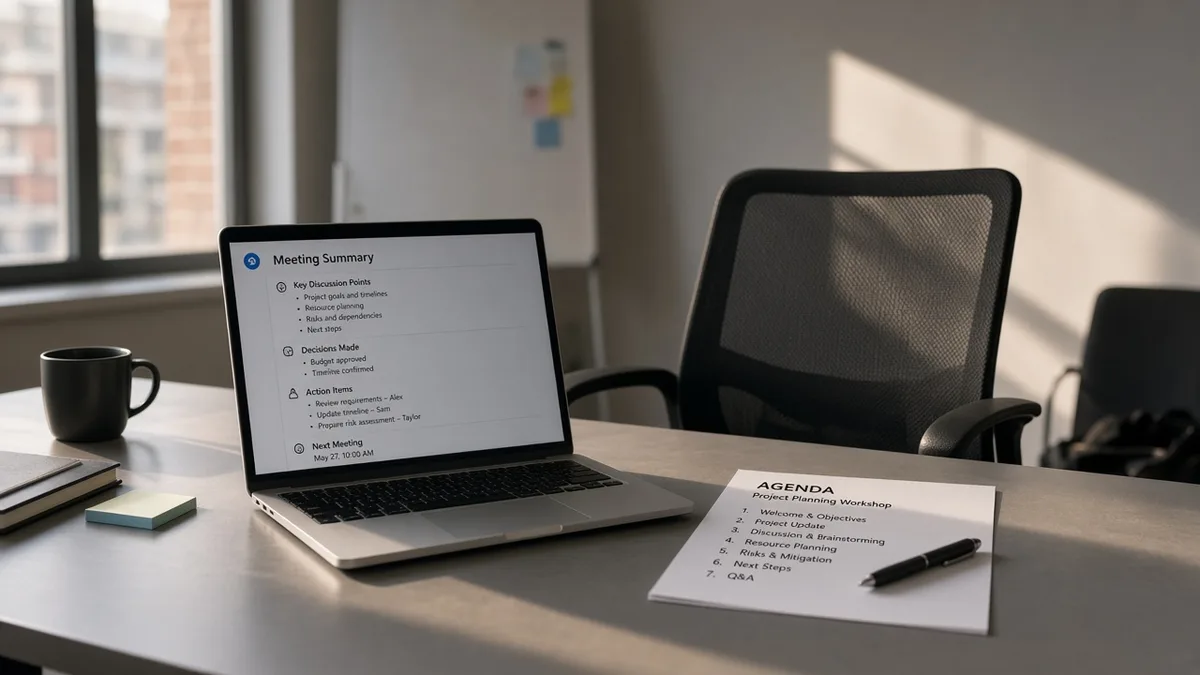
The BA who covered the clinic-workflow workshop pinged me at 4:40pm: "Copilot notes are in the chat — looks solid." I had been in a different steering. By 5:15 the recap was already the unofficial minutes. Decisions listed. Action items named. A tidy paragraph that made the afternoon sound settled.
I was not in the room. The summary made it feel as if I had been.
That is the failure mode this piece is about — not "AI is bad at meetings," but what an absentee must verify before an AI workshop summary becomes the requirements record.
Recap-as-Record — What Goes Wrong
Call the trap Recap-as-Record: forwarding or building from an AI summary as if it were minutes you witnessed.
If the phrase is new, keep this version: fluency promotes the document from draft to authority without a human gate.
Meeting summarisation research names the expensive error types plainly — missing information, misattribution, hallucination. In practice they look ordinary. "Agreed: overnight batch stays" when the room only parked the question. An action assigned to someone who never spoke. A hedge — "if pharmacy confirms" — dropped so the sentence sounds decisive. Could becomes will.
Microsoft's own guidance is not coy: validate Copilot output before you act on it, share it, or rely on it in a decision. Catch-up features are built for speed — summarise what you missed, move on. Speed is useful. Speed without a check is how fluent wrong specs start.
Anticipate the pushback: "I was busy; the recap is better than nothing." Better than nothing is not the same as safe to build from. The identity claim underneath Recap-as-Record is seductive: I caught up. Useful when the Pass clears. Costly when the Pass was skipped and the estate ships the summary's confidence.
This is adjacent to, not a remake of, how AI summaries strip requirements nuance when you were in the conversation. Here the stake is sharper: you have no embodied memory of the hedges. The document is all you have until you verify.
The Claim Sheet Pass — Four Checks
Call the practice a Claim Sheet Pass: a short verification that treats every decision, owner, hedge, and silence in the AI recap as a claim to prove — not a fact to inherit.
Plain version: do not promote the summary to working record until four checks land or you stop.
Check 1 — Decisions. Jump to decisions and action lists first, not the narrative opening. For each "agreed" or "decided," search the transcript for the anchor noun. Read sixty seconds of context. If the room deferred, parked, or disagreed, the summary invented finality. Delete or rewrite before anyone builds.
On the clinic workshop the Copilot list said overnight batch stays. Transcript search for "batch" found a pharmacist asking to wait until Monday's volume check. Parked. Not decided. That one check saved a fortnight of false certainty in the build pack.
Check 2 — Owners. For every action item, confirm the person was present and accepted the work. Invented actions often look reasonable — a familiar name, a familiar follow-up. Silence in the room is not consent in the summary.
Check 3 — Hedges. Hunt modality. Could, might, if, unless, after. Summaries love clean future tense. Practitioner reviews keep finding the same collapse: conditional speech rewritten as commitment. Restore the hedge in your working notes even if you leave the AI file untouched.
Check 4 — Silences. What topics were on the agenda and absent from the recap? What open questions disappeared? Omissions read as completeness. Ask one living witness: "What felt unfinished when you left?" Their answer is part of the Pass.
Budget: minutes, not a second workshop. Four checks beat rebuilding a wrong integration path later.
Transcript, Witness, Stop Conditions
Post-meeting Copilot insight depends on what was captured; without a transcript you can search, Checks 1–3 have nowhere to land. Long sessions and thin content already limit quality. No transcript is not a small inconvenience. It is a stop. Do not promote the recap to requirements. Ask for notes from a person who was there, or re-open the decision in a short follow-up.
Transcripts fail too — diarisation swaps speakers, ASR invents phrases. For high-stakes claims, pair transcript search with one living witness. If they disagree, escalate. Do not average the conflict into a smoother sentence.
Partial attendance (joined late) still runs the Pass on the segment you missed. Recurring weekly meetings raise cross-contamination risk: last week's agreement bleeding into this week's recap. Prefer claims grounded in this transcript.
Where Personal Verification Stops
The Claim Sheet Pass is absentee literacy. It does not replace a team paste agreement before client context enters a model. It does not replace a critical-thinking audit of an AI-assisted discovery pack before workshop sign-off. It does not replace Spoken Accept when one of you prompts AI in a live pair review. Those are different jobs for people who were in the room, who own the pack, or who are mid-session.
It also does not replace Legal on recording consent. If you cannot lawfully access the recording or transcript, stop and escalate — do not invent a parallel shadow note from memory of a chat snippet.
Your job when you missed the workshop is narrower: refuse Recap-as-Record until the Claim Sheet Pass clears. The tool can draft. You still own what you build next.
Verify the decisions.
Verify the owners.
Verify the hedges — or treat the silence as unfinished business.
Related

AI-Assisted Test Cases — What Still Needs a Human Oracle
The suite can look complete while the estate is still wrong — fluency is not an expected result.
5 min · October 27, 2026
Governing AI-Assisted Discovery Before the Team Normalises It
A lead-owned Discovery Norm Map — paste, recap, pack, escalate — before habits become law.
5 min · September 14, 2026
What an AI Summary Removes From a Requirements Conversation
The handover looked complete. The transcript still held the condition.
7 min · June 24, 2026