Delegating Judgment to AI — a Boundary Map for Analysts
Most teams have a prompt library. Almost none have a line that says what still needs a human name on it.
 Ihor NesterenkoIT System Analyst6 min read · Jul 7, 2026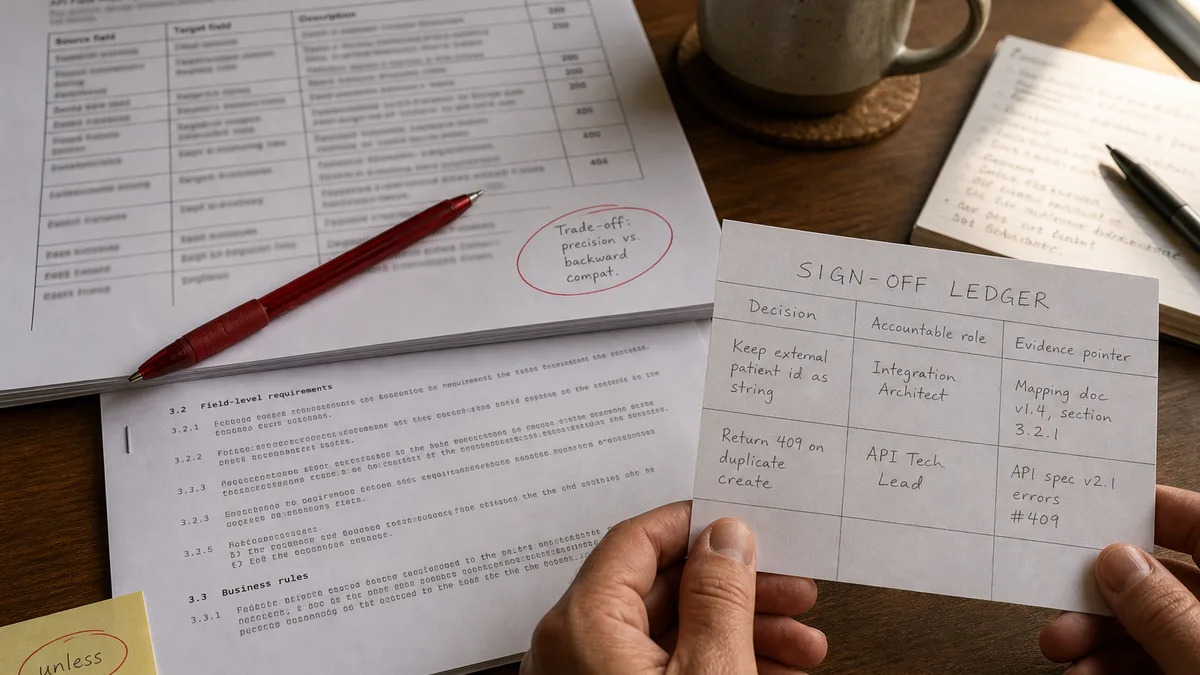
Most analysts have used a model to draft a user story, summarise a workshop, or propose a field mapping. Far fewer have written down which judgments they are still willing to defend when a stakeholder asks, in a calm voice, who decided.
The gap is not caution. It is architecture.
Organisations version prompts, audit model calls, and paste "human in the loop" into slide decks — then ship requirements where the only human act was approving fluent prose. A programme manager accepts an AI-generated section because it reads confidently. Nobody with authority has weighed the trade-off buried in paragraph four. When the integration misbehaves in production, accountability searches for a person and finds a workflow.
What Prompt Libraries Actually Govern
Prompt libraries matter. Versioning, ownership, tiered review for high-risk use cases — this is how mature teams treat prompts as governed assets rather than private improvisation. NIST's AI Risk Management Framework expects oversight processes to be defined, assessed, and documented — not merely hoped for.
Libraries govern text: which instruction bundle produced which draft, who approved the bundle, what inputs it saw. They do not decide whether those inputs should have entered the tool in the first place — that needs a team agreement before the first paste of client context. Before either artifact exists, personal habits are what juniors actually copy.
They do not, by themselves, govern judgment: which organisational commitment that draft makes, who is accountable if it is wrong, whether a trade-off was actually weighed. Research on governance gaps notes that system-level frameworks often stop short of artifact-level lifecycle rules for prompts in production. Different problem. Same Tuesday afternoon when someone asks who signed off.
Teams invest in prompt hygiene while leaving evaluative work undefined — the work of saying we accept this constraint, we reject that approach, this department owns the override.
A library tells you how the words were produced. It does not tell you who owns the decision the words encode.
That is the gap prompt libraries were never designed to close.
The Boundary Map — Four Zones of Judgment
Analysts need a map, not another template pack. I use four zones. Each zone answers one question: what kind of judgment is this, and may it leave my desk without a name on it?
-
Zone 1 — Operative — Rephrasing, formatting, first-pass structuring, generating candidate acceptance criteria from notes you already accept. Delegate freely. You are saving keystrokes, not committing the organisation.
-
Zone 2 — Propositional — Claims about how the system works, field mappings, error codes, interface shapes. The model may draft; you must verify against source material. This is assistive drafting with an evidence bar, not sign-off.
-
Zone 3 — Evaluative — Trade-offs under constraint: whose priority wins when rules conflict, what failure is acceptable, what the organisation will tell a regulator or a patient. Retain this. The model can articulate options; it cannot hold accountability for choosing among them.
-
Zone 4 — Attributive — External commitments: SLAs, consent scope, financial liability, go-live gates, named ownership when things go wrong. Named human sign-off only. No anonymous "the system shall."
If a line in your spec moves from Zone 2 toward Zone 3 because it smuggles in a budget decision or a policy call, that is the signal to stop delegating and start deciding.
Operative Agency and Evaluative Agency
Regulators and researchers increasingly distinguish two kinds of contribution in human–AI teaming. Operative agency is the model exploring pathways — draft mappings, candidate workflows, alternative wordings. Evaluative agency is yours: judging whether those pathways align with constraints the organisation actually accepts — legal criteria, fairness targets, who bears the cost when the slot engine and the clinical rota disagree.
Requirements engineering for GenAI-enabled systems frames this as oversight requirements: where human judgment applies, how decisions are reviewed or overridden, how accountability is traced through the lifecycle. That is more useful than a checkbox that says "analyst reviewed."
The EU AI Act's human-oversight article — relevant where high-risk systems are in scope — does not ask for a person nearby. It asks for overseers who understand limits, who can override output, and who remain aware of automation bias when the system offers recommendations for human decisions. NIST's playbook pushes the same direction: clarify the appropriate level of human involvement, not merely its existence.
For a working analyst, the translation is simple. Delegate operative work. Stand guard on evaluative work. Do not confuse a polished Zone 2 draft for a finished Zone 3 judgment.
Worked Example — Scheduling Integration Requirements
Picture a healthcare programme connecting a hospital appointment system to a regional scheduling hub. The analyst's job is familiar: message formats, retry behaviour, what happens when a slot disappears between booking and confirmation.
The model handles Zone 1 well. It turns workshop bullets into tidy user-story format and proposes a first-pass JSON schema. Zone 2 work — mapping patient_id to the hub's subjectRef, listing HTTP status codes for a partial sync — also belongs in delegation, with verification against the interface guide and a test message from staging.
Zone 3 begins where priorities collide. The workshop noted that clinical staff may cancel within two hours without penalty; operations wants the hub to treat any cancellation as a failed booking attempt for SLA reporting.
An AI draft can phrase both sides fluently. Choosing which side the integration implements — and documenting the cost of the choice — is evaluative. The model has no standing to decide.
Zone 4 is smaller but non-negotiable. The consent scope for which identifiers cross the boundary. The named owner when the hub's availability disagrees with the theatre schedule. The go-live condition that legal signed off on — not paraphrased, not "implied" by a confident shall-statement. Those lines carry a person's name, a date, and a pointer to evidence.
In practice, the safe split looked like this: twelve pages of draft from the model, three paragraphs the analyst rewrote after re-reading the workshop transcript, and four ledger rows — described below — that travelled with the spec into review.
Ceremonial Oversight — Present but Not Deciding
Automation bias is the tendency to favour automated output over your own reading of the source material. It is strongest on unfamiliar, objective tasks — exactly the field mappings and error catalogues analysts happily delegate. Explanations from the model do not reliably fix this; studies find they may even increase compliance with wrong suggestions while still improving speed. Engagement beats transparency: independent checks, not richer rationales from the same system you are trying to doubt.
Ceremonial oversight is what remains when a human is formally in the loop but substantively ratifying.
The programme manager approves the Confluence page. Nobody searched the transcript for unless. Reviews become approve-or-reject without classifying why — the failure mode auditable-flow design warns about when human steps lack criteria and outcome categories. Public-sector reviews of high-risk AI note the same pattern under time pressure: the human is adjacent to the algorithm, not positioned to scrutinise it.
The dangerous delegation is the fluent one.
For analysts, the corrective is not more meetings. It is narrower sign-off on Zone 3 and Zone 4 items, with evidence attached — which turns oversight from theatre into something you could reconstruct six months later.
The Sign-off Ledger — Three Fields
Teams afraid of bureaucracy often over-correct into none. A one-page Sign-off Ledger beside the spec is enough. Each row is one Zone 3 or Zone 4 judgment. Three fields:
-
Decision — One sentence, no hedging stack: what was chosen or rejected.
-
Accountable role — The human role that owns the consequence, not the tool that drafted the sentence.
-
Evidence pointer — Workshop timestamp, policy clause, ticket, or test result that grounds the call.
Twelve pages of AI draft. Four ledger rows. That ratio is the point. Libraries govern how the twelve pages were produced. The ledger governs what the organisation is willing to defend.
Judgment delegated well is not judgment avoided — it is judgment concentrated where a name still matters when someone asks.
More in People
Critical Thinking Audit for AI-Assisted Discovery
A complete-looking pack can still file a number nobody said as a workshop outcome.
7 min · August 19, 2026

Red-Teaming Your Own AI-Assisted Spec Before Sign-Off
Three probes on your draft — not the model's wording, and not a detector score.
6 min · July 24, 2026

What an AI Summary Removes From a Requirements Conversation
The handover looked complete. The transcript still held the condition.
6 min · June 24, 2026