The Hidden Cost of "Everyone Should Be Involved"
Adding one more person to the decision doesn't add one more conversation. It adds all of them.
 Serhii MalyshevSoftware architect and tech lead6 min read · Jul 3, 2026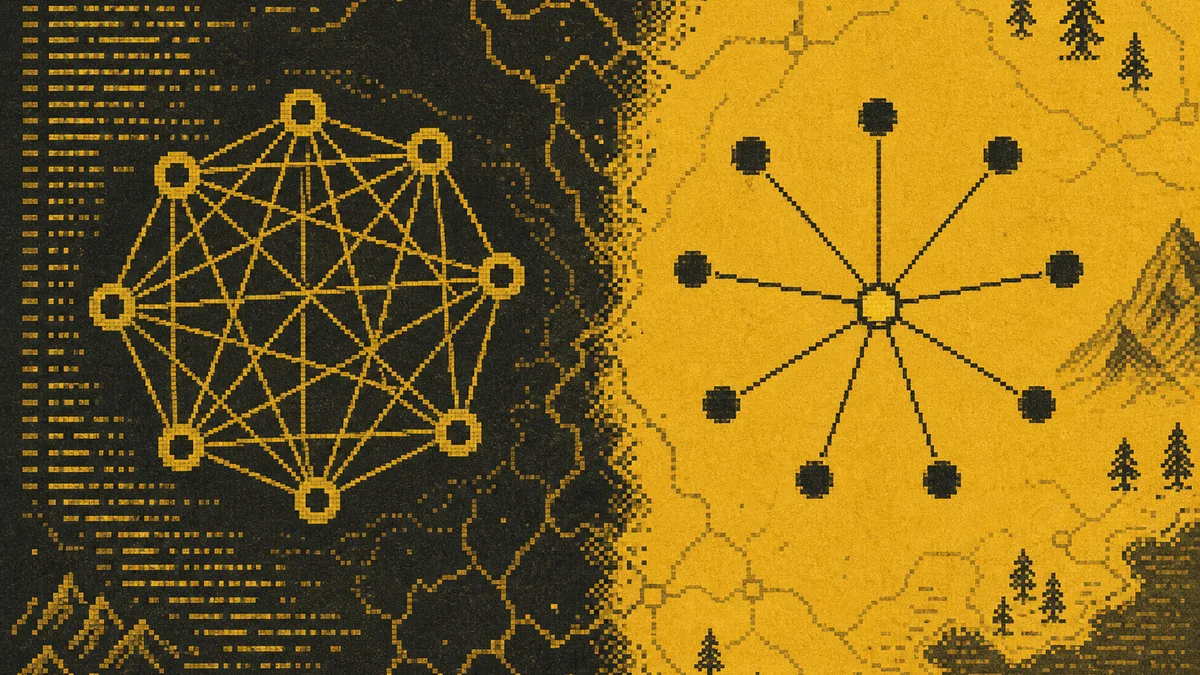
You know the moment. A decision two people could have closed over coffee gets a wider audience — "let's make sure everyone's in the loop." Someone adds three more names to the thread. Someone else adds a channel. By Thursday the decision is a forty-message thread, two side DMs, and a meeting to align on what the meeting is about — classic ceremony that proves inclusion while the decision stalls.
Nobody did anything wrong. Everybody was being generous. And the work got slower.
That generosity has a name — communication overhead — and it doesn't grow with the headcount. It grows with the square of it.
The Mesh Tax — Why "Everyone" Scales Like n²
Here's the part "let's loop everyone in" quietly ignores. When you connect n people so each can talk to each, you don't get n relationships. You get n(n−1)/2 of them. That's every pair, and pairs pile up fast.
Two people: one line. Four people: six lines. Eight people: twenty-eight.
Double the room and the connections don't double — they roughly quadruple. Brooks named this in The Mythical Man-Month: intercommunication effort grows as n(n−1)/2, and it can "fully counteract the division of the original task." It's the engine behind Brooks's Law — adding people to a late project makes it later.
Put numbers on a real team and it stops being cute. Amazon's own math: a six-person team carries fifteen relationships, a twenty-five-person group carries three hundred, and fifty people carry 1,225 connections. Nobody maintains 1,225 of anything. So they stop trying, and the mesh starts dropping packets.
Call it the mesh tax. Every person you add to a decision is a new edge on every existing node — and you pay interest on all of them.
The tenth person doesn't cost you one conversation. They cost you nine.
Feels Like Collaboration, Bills Like Bureaucracy
So why do we keep doing it?
Because adding people feels good. Inclusion reads as respect. Excluding someone feels like a slight you'll have to explain later. Widening the room is the conflict-avoidant move — nobody has to tell anyone "you're not needed for this one."
But the warm feeling is exactly what hides the cost. The productivity drop even has a name: the Ringelmann effect. As a group grows, output per person falls, from two directions at once — coordination loss, where efforts stop lining up, and motivation loss, where each person quietly trusts the others to carry it. It's not a folk complaint. A study of 58 open-source projects and more than half a million commits found the same curve in real software teams: bigger group, less output per head.
This is the trap. The thing that feels collaborative — everyone present, everyone weighing in — is the same thing producing less per person and taking longer to do it.
Inclusion feels like collaboration. Past a small number, it bills like bureaucracy.
"But You'll Create Silos" — the objection, taken seriously
Here's where someone raises the real counter-argument, and it's a good one: narrow the decision core and you get silos, bus-factor-of-one, and a team that resents being handed conclusions it never got to shape.
True. All of it. If "smaller core" means three people vanish into a room and emerge with edicts, you've traded one failure for a worse one.
But that objection assumes involvement is binary — you're either in the room or in the dark. It isn't. There's a difference between being consulted and being informed, and collapsing the two is the actual mistake.
Consulted means your input shapes the decision. You're an edge in the mesh, and you cost what edges cost. Informed means you see the reasoning and the result. You're on a broadcast, and broadcasts are cheap.
Most people who "should be involved" need to be informed, not consulted. They don't want a seat at the table. They want to not be surprised.
Broadcast wide. Decide narrow.
The Hub Beats the Mesh
Once you separate consulted from informed, the fix is a shape, not a headcount.
A mesh is everyone talking to everyone: n² edges, no center, latency everywhere. A hub is one coordinator who gathers input and broadcasts out: n edges, one center, and makers who get to stay makers.
Same people. Different topology. Wildly different bill.
You've seen the hub work under pressure. A real incident doesn't get resolved by twelve engineers DMing each other twelve different theories. It gets resolved by one incident commander who holds the thread, pulls in exactly the people a given step needs, and broadcasts status to everyone else watching. The commander is the hub. Everyone else is consulted for their slice or informed on the channel. Nobody runs the full mesh — that's the entire point.
Conway saw this in 1968. Past a modest size, he wrote, it becomes "necessary to restrict communication in order that people can get some work done." Restrict isn't a dirty word there; it's the enabling constraint.
And Conway left the sting in the tail: the system you ship ends up shaped like the communication structure that built it. A team that talks in a tangled mesh ships a tangled mess.
So centralized communication isn't the opposite of collaborative. It's collaboration that spends its coordination budget on purpose instead of leaking it everywhere. Amazon's two-pizza rule is the same instinct wearing a joke: keep a team small enough that lines of communication stay cheap, and when demand grows, split into more small teams rather than inflate one big one. Two pizzas was never about lunch. It's a coordination bound.
Someone Decides. Everyone Knows.
The narrow end of the hub needs a name on it, or the "small core" quietly re-expands until it's a committee again.
Apple's version is the DRI — the directly responsible individual. One person is accountable for a given decision. They don't do all the work and they don't decide in a vacuum; they consult, then they own the call. This isn't autocracy. It's that "everyone is responsible" is functionally identical to "no one is," and a single owner is what stops the diffusion of responsibility a big room manufactures.
One owner, consulting a few, broadcasting to many. That's the hub, staffed — the opposite of a cross-team ping storm with no decision packet.
The hub has its own failure mode, and it's worth naming: the coordinator can become a bottleneck if they insert themselves into every call instead of routing it. A hub that hoards decisions is just a mesh with extra latency. The fix isn't a bigger core — it's an owner who delegates the reversible calls and saves their attention for the ones that actually need a center.
When Everyone Actually Should Be Involved
None of this means default to a bunker.
Some decisions are worth the mesh tax. Anything irreversible and expensive to unwind — a values call, a name you'll carry for years, a reorg, a safety tradeoff — earns wide, genuine consultation, because the cost of quiet exclusion dwarfs the cost of coordination. When the decision is a one-way door, pay for the extra edges.
The mistake isn't ever involving everyone. The mistake is involving everyone by default — on the reversible, two-way-door decisions that make up most of the week, the ones a single owner and a broadcast channel would close cleanly by Tuesday.
Match the topology to the stakes. That's the whole skill.
"Everyone should be involved" isn't generous. It's a bill you can't read until it arrives.
So price it before you send the invite. Consult the few who change the answer. Inform the many who only need to see it. And put one name on the decision, so the rest of the room can get back to work — including sprint planning, where "everyone must weigh in on every card" is the same mesh wearing Scrum clothes.
Related

Your First Architecture Review — How to Run It
The review you should worry about is the one where nobody objected.
9 min · September 7, 2026

How to Switch Teams Without Burning Bridges
A polite goodbye does not stop the hallway sentence from opening your next 1:1.
7 min · August 21, 2026

Cross-Team Dependencies — How to Not Get Blocked
The Slack ping, the escalation path, the meeting that should have been an email — and when each is right
6 min · August 3, 2026