What Actually Happens in Sprint Planning
The mechanics nobody explains to engineers joining their first Scrum team
 Serhii MalyshevSoftware architect and tech lead7 min read · Jul 10, 2026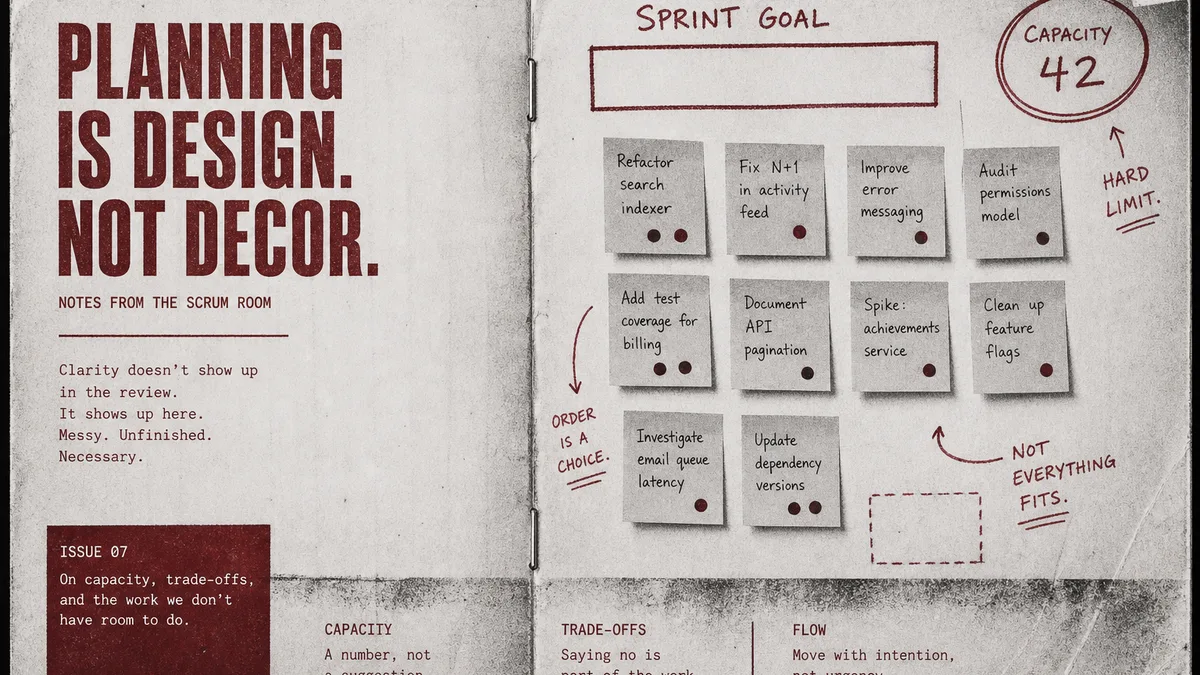
Most Sprint Planning meetings don't fail because the team skipped a ceremony. They fail because the room runs three jobs as one — and the job that wins is "fill the board until the points run out." When that packing list is also the only place retro commitments go to die, you've stacked two failures into one invite.
The invite says collaboration. The clock says packing list. By the time someone remembers the Sprint Goal, the stickies are already committed and the risk that mattered never got a sentence.
That's the room you're walking into.
Here's how to read it.
The Room You Walk Into — not the ceremony on the poster
Your first planning looks like a status meeting with estimates. Product Owner scrolls a backlog. Someone opens last sprint's velocity. Cards get sized. Numbers get summed. The board fills. People nod. The calendar invite ends — and if that hour never changed a decision, you've paid the Visibility Ledger tax again.
What you just watched is not what the framework asks for.
And it's not what a healthy planning room is negotiating.
The Scrum Guide frames Sprint Planning as three topics: why this Sprint is valuable, what can be Done, and how the chosen work gets done.
The outputs are a Sprint Goal, selected Product Backlog items, and a plan for delivering them — together, the Sprint Backlog.
Most teams skip Topic One, rush Topic Two as a point-matching exercise, and treat Topic Three as optional homework after the meeting.
Topic One is where the Goal lives. Skip it and you're already packing.
What the Guide Actually Asks For
The Guide's ceiling is eight hours for a one-month Sprint — usually shorter for shorter Sprints. Treat that as a max, not a target.
Product Owner brings the "why" and the ordered backlog. Developers select what goes in and own how it becomes Done. Nobody else dictates the how.
Two absences break the ceremony. No Product Owner means no trade-off authority. No Developers means no forecast worth trusting.
Planning without either is almost impossible — you're scheduling and calling it Scrum.
Selected work is a forecast, grounded in past performance, upcoming capacity, and the Definition of Done. The named commitment of the Sprint Backlog is the Sprint Goal — not the point total on the board.
If your team says "we committed to 34 points," they used the wrong noun.
The commitment is the Goal. The board is a forecast.
The Three Jobs — and the one that eats the other two
In a room that works, planning finishes three jobs.
Select — pick work that can finish inside the Sprint, not work that looks impressive on a roadmap slide.
Goal — form a single objective worth defending on Wednesday when something blows up.
Risk — surface the delivery landmines before they become mid-sprint surprises: migrations without rollback, dependencies that aren't in the room, the story everyone estimates as an 8 while one person knows it's a rewrite.
Fill-the-board collapses all three into one habit: keep pulling items until the sum matches last sprint's velocity. Selection becomes packing. The Goal becomes a Confluence afterthought. Risk stays quiet because quiet is faster — and because naming risk feels like slowing the room down.
Here's the payments-squad version. Two-hour planning. PO brings eight "must" stories — OAuth cleanup, ledger migration, three billing bugs, a dashboard tweak, a partner API spike, and a "quick" report. Team average velocity: 34. Someone subtracts one PTO day and announces "we have about 40." Cards get estimated. Spreads get averaged. At minute 95 someone asks what the Sprint Goal is. Someone types "Deliver sprint backlog items for payments reliability." The board shows 40 points.
The ledger migration's missing rollback never gets a sentence. Mid-sprint, that silence becomes the incident. The board still looks full. The Goal still says "reliability." Nobody can use either to decide what to drop.
That room didn't plan. It filled.
Fill-the-board isn't laziness. It's the path of least resistance when Topic One never got a real minute.
You might think the fix is better estimation.
Estimation is an input technique — useful, not the ceremony. Planning is the negotiation about which of the three jobs get finished before the timebox ends.
Capacity Fiction — the number that feels honest and isn't
Capacity looks like math. Available people times focus factor. Subtract PTO. Match velocity. Ship the number.
The number is political long before it's arithmetic.
Velocity-driven planning — select work until the points equal the average — anchors the room. Once the sum matches "what we usually do," the team is predisposed to say yes even when the Sprint isn't that size.
Matching last sprint's points feels like honesty. It's often just anchoring with a spreadsheet.
Real capacity has layers the velocity number ignores: corporate overhead, plannable time, and buffer for emergencies, tasks that grow, and tasks nobody named in planning. Fill to the brim and you've planned a best-case Sprint. Best-case Sprints produce spillover.
Carryover is the invisible second Sprint. Team of five. "40 points available" after one PTO day. Thirteen points of unfinished work still sitting on the board from last time — never subtracted from the 40. Planning ends at 40 committed. The carryover is still there. You didn't plan 40. You planned 53 and called it 40.
That's capacity fiction wearing a clean number.
Teams don't need a leader to overfill. Optimism does it first. Pressure — even a PO's "must-have" tone — pushes an already-optimistic forecast underground. The risks don't disappear. They stop getting airtime.
Wallpaper Goals vs Goals That Survive Wednesday
A Sprint Goal is supposed to be the single objective for the Sprint — a commitment that still leaves flexibility on the exact work needed to hit it. Mid-sprint, if the work turns out different than expected, you negotiate scope with the Product Owner without changing the Goal.
That only works if the Goal can make a decision.
Wallpaper Goal: "Improve payments reliability and deliver the sprint backlog." Delete it. The board still "makes sense."
You never had a Goal. You had a packing-list slogan.
Usable Goal: "Customers can complete checkout with the new ledger path — old path still available as rollback." Delete it and the board loses its spine. The migration story stays; the unrelated dashboard tweak has to justify itself against Wednesday's trade-off.
Weak goals sound like "finish the stories" or "improve retention" with no outcome attached. Strong ones answer why this Sprint is worth the investment and what "done enough" looks like for the objective — not for every sticky on the wall.
If the Goal can't help you say no mid-Sprint, it failed in planning.
A Sprint Goal that can't force a trade-off is wallpaper.
What a First-Timer Should Listen For — and say
You're not there to facilitate. You're there to not get steamrolled by fiction.
Listen for estimate spreads. A 3 / 8 / 13 on the same story is not averaging homework. It's a risk signal. The outlier often knows something the room's pace doesn't want to hear — missing rollback, unknown dependency, "we've never done this in production." Ask what the high card is protecting against. Don't propose the mean.
Listen for "must-have" without a Goal. When the PO stacks musts, ask which single objective those musts serve. If the answer is "all of them," you're back in packing-list mode — and everyone in the room is about to pay for a decision that needed three people, not twelve.
Selection without a Goal is just prioritization theater.
Listen for capacity that ignores carryover and interrupt load. If last Sprint's unfinished work is still on the board and nobody subtracted it, say so once, plainly: "We're planning 40 on top of 13 still open." You're not sandbagging. You're refusing to launder spillover into a clean number.
You might worry that speaking up is political — that the room wants reassurance, not risk. Sometimes it does. Say the risk anyway, once, without a speech. Forecast, plan, and commitment are different words; treating them as synonyms is how teams lose credibility sprint after sprint. Staying quiet to keep the peace just moves the argument to Wednesday, when the options are worse.
The quietest person in the room often holds the real risk. If they shrug while everyone else converges, ask them what they're not saying.
One question. Then stop talking.
So What Do You Do Monday?
Walk into the next planning with one question ready — not a speech.
When the board is almost full and the Goal slot is still blank, ask: If we delete the Sprint Goal right now, does this board still make sense?
If the answer is yes, you have a packing list with a velocity number on it.
Which of the three jobs is your room about to sacrifice so the board can look full?
Related
Building a Technical Roadmap That Survives Reality
Quarterly planning when the requirements change monthly and the backlog is a lie
8 min · August 17, 2026

When Self-Organization Becomes Abdication
The team left to figure it out alone — where autonomous stops being a compliment
6 min · August 14, 2026

Engineering Goals That Don't Evaporate
Setting and holding quarterly goals when every sprint is already on fire
7 min · July 12, 2026