Your First Performance Review — How to Prepare
What to bring, what to say, what to ask — the version nobody gives you before the meeting
 Serhii MalyshevSoftware architect and tech lead7 min read · Jun 25, 2026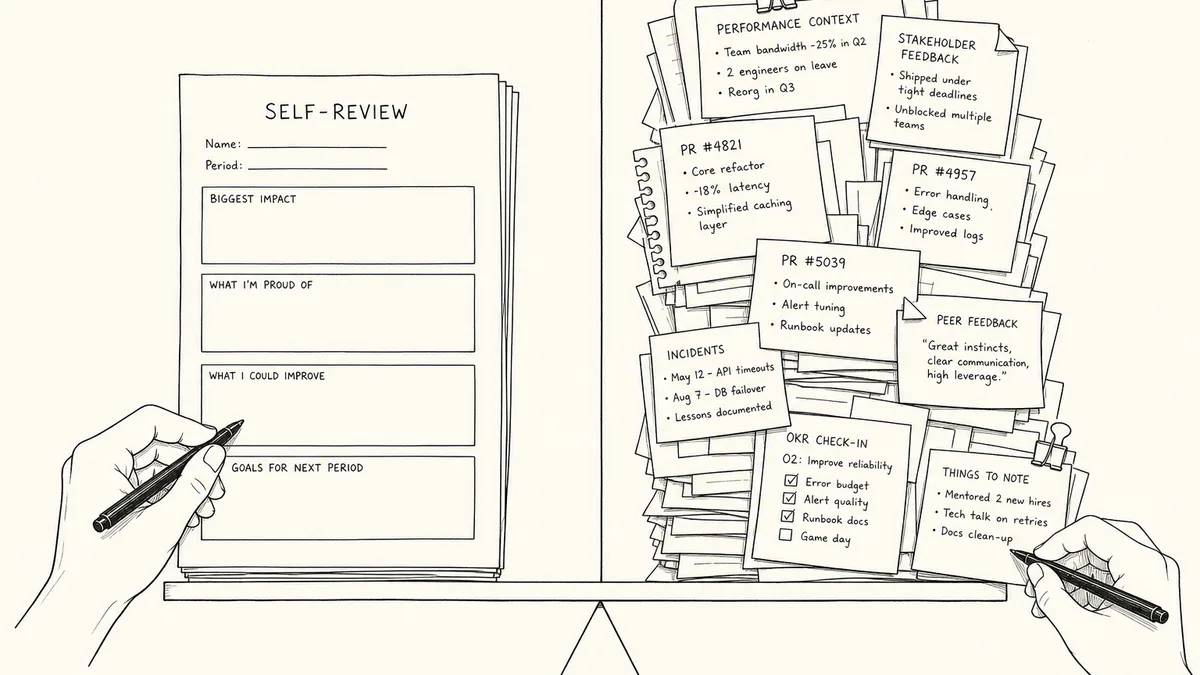
Every company schedules performance reviews. HR sends the self-assessment form. Your manager blocks an hour. Almost nobody tells IC engineers what to put in the folder before that hour starts — and first-timers walk in treating the meeting like a verdict instead of a briefing.
You know the calendar invite is coming. What the onboarding deck skips is the prep packet: evidence dossier, manager one-pager, question card. Skip that and your rating rides on whatever your manager remembers from the last sprint — not the migration you carried in March.
Everyone Gets a Calendar Block — Few Build a Prep Packet
Manager playbooks cover listening ratios and calibration meetings. Employee-facing guides stop at "be honest on the self-review form." Orosz names the failure mode directly: managers miss work they didn't see, and they overweight whatever landed last week. Recency bias, in HR speak. I call it the Recency Trap — your November on-call fix counts; your February design doc doesn't, unless you put it on the record.
The HR template isn't preparation. It's an empty vessel. Evans's brag document practice exists because memory fails at review season — and because some engineers undersell impact they'd remember if prompted. First review is when that asymmetry hurts most. You haven't learned which wins managers notice and which ones vanish into merged PRs.
Treat the review like a design review you own. You wouldn't walk into an architecture meeting with vibes. The same prep habit that makes a 1:1 useful — shared doc, slots, send-ahead — scales to the annual hour.
Same rule here.
The Review Prep Packet — Three Artifacts, Not One Essay
Build three artifacts. Different jobs. Different send times. Fairness isn't politeness — it's evidence delivery.
-
Slot 1 — Evidence dossier — Living brag doc or weekly work log. Raw material: PR links, design docs, postmortems, "unblocked payments squad" notes, thank-you quotes from Slack. Update weekly if you can; marathon session if you must — Evans on capture, Orosz on the work-log template. This file is long. It is not the form you paste into Workday.
-
Slot 2 — Manager one-pager — One screen. Top five wins with numbers. One growth area you're already working. One ask for next half — scope, level conversation, project bet. Send 48 hours before the meeting, per engineer prep playbooks. Subject line:
Performance review context — [Your name]. -
Slot 3 — Question card — Three questions on paper or in your notes app. You read them when the manager asks "anything else?" — not when you're flustered by unexpected critique.
Worked example — mid-level backend engineer, first annual review
- Dossier — Google Doc titled
2025 work log, ~35 weekly bullets rolled into sections: Auth migration (6 entries), On-call (4), Mentoring (3). Links to RFC, postmortem, two latency graphs. - One-pager — (1) Cut checkout p95 40% via cache layer — link. (2) Owned token refresh migration — zero customer-facing incidents. (3) Wrote on-call runbook adopted by adjacent team. (4) Mentored two juniors through first prod deploys. (5) Growth: presenting at guild; already signed up for November slot. Ask: own checkout reliability scope H1.
- Question card — "What would exceeding expectations have looked like for the auth migration?" / "What's the gap between my current level and senior on our rubric?" / "What should I stop doing to make room for reliability ownership?"
Fifteen minutes to assemble the one-pager if the dossier exists. Two hours if you're reconstructing March from git blame — and you'll still miss the Slack thread where you unblocked payments.
Writing the Self-Review — Four Sections, Engineer Timing
Your company's form maps to a structure Orosz documents for engineers even when HR doesn't label it this way:
-
Goals / expectations — Restate what "good" meant this cycle. If goals were never written down, say your understanding out loud. Unclear expectations are a follow-up item, not a footnote.
-
Accomplishments — Priority order. Action + metric + timeframe where you can. "Shipped feature" is a task. "Reduced failed checkouts 12% over Q3 by fixing race in token refresh" is evidence.
-
The "how" — Mentoring, code review depth, cross-team unblocking, postmortem facilitation. Managers see half of this at best. Quote a thank-you. Name a team you helped. Output gets you to meets; influence language gets you to exceeds.
-
Competencies / levels — Map work to the rubric your company uses. Even bullet points beat leaving it entirely to manager inference.
Link the dossier at the bottom. Don't paste forty bullets into the HR textarea.
Send the self-review before your manager finalizes theirs — not the morning of. You're supplying evidence, not performing humility — HBR treats the self-assessment as shaping the manager's evaluation, not optional paperwork.
The 48-Hour Send-Ahead — Script and Subject Line
The Engineering Manager's review guide assumes managers share write-ups before the meeting so bad news isn't a magician's reveal. Flip it. You send first — your summary lands in their prep stack, not your panic stack.
Email body — four sentences:
Attached is my self-review and a one-page summary. Top outcomes: [three phrases]. I'm actively working on [growth area] — [one concrete action]. For the meeting I'd like time on [ask] and I've listed three questions at the bottom. Happy to adjust if you need anything earlier for calibration.
Optional: 20-minute pre-brief 1:1 the week before if your culture allows. "Want to make sure you're not surprised by anything in my self-review." Not lobbying — just making sure nothing in your packet is news to them.
If they haven't read it when you sit down, don't sulk. Say: "I sent a summary — want to start with the auth migration win or your overall read?" Once. Then move on.
In the Room — What to Say When They Talk
Both sides already read the doc. Good managers resist reading it aloud and steer toward praise and critique you can act on. Your moves:
When they skip a win. Calm correction: "I'd also want credit for the runbook — platform team adopted it and it cut their onboarding time. Is that reflected?" Once. With a link if needed — name the gap calmly when the rating doesn't match the dossier.
When critique lands. HBR's bad-review framing applies: treat it as data, not identity. Notes in the Action items section — who owns what by when. Ask for examples if feedback is vague.
When money enters the chat. Separate compensation from the performance conversation when you can. Comp talks later — performance talk first. If your org bundles them, listen to the rating first. Schedule a follow-up for numbers if the hour gets hijacked by arithmetic — and bring a Raise Brief to that follow-up, not vibes.
Spend half the meeting backward, half forward — goals for next cycle, not a retrospective filibuster.
Three Questions That Change the Rating
These aren't polite filler. They're how you turn a label into a contract.
-
"What would exceeding expectations have looked like this cycle?" — Surprising meets becomes a gap analysis against real work.
-
"What's the specific gap between my current level and the next on our rubric?" — Forces rubric language instead of vibes.
-
"What should I stop doing to make room for [the scope I want]?" — Trade-off question managers respect. Shows you're negotiating bandwidth, not begging.
Write answers in your notes before you leave. If the manager can't answer, that's information about the process, not just you.
When the Review Goes Sideways
Unprepared manager, surprise low rating, vague "needs improvement" — document before you stand up.
Agreed actions go in writing same day: bullet list emailed to your manager with "confirming what we aligned on." Schedule a 60-day follow-up on the calendar in the room. Bad-review prep is about closing the loop early, not litigating in the hallway.
Pair with a peer on the dossier next cycle. Evans's pair review catches undersold impact — especially the invisible glue work first reviews ignore.
What Changes This Week
Start the dossier today. One bullet: what shipped, who it helped, link if you have it. Ten minutes.
If review season is weeks away, send the one-pager early anyway. If it's tomorrow, triage: five wins from git and Slack search, three questions on a sticky note, ask for a follow-up if the hour isn't enough.
The form is empty until you fill the packet.
Bring evidence. If your status updates already went flat while the dossier stayed empty, check the burnout observables before you blame the form.
Ask for the contract.
More in People

How to Switch Teams Without Burning Bridges
A polite goodbye does not stop the hallway sentence from opening your next 1:1.
7 min · August 21, 2026
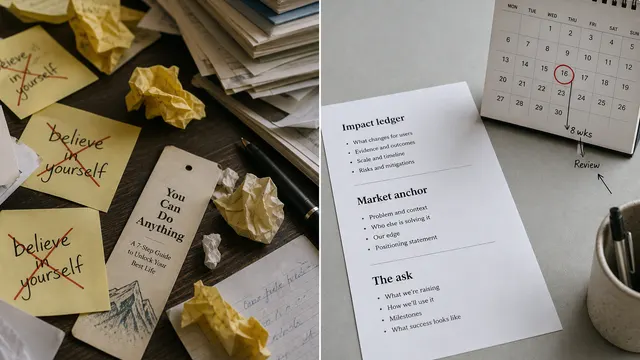
How to Ask for a Raise as an Engineer
The conversation, the timing, the number — without the confidence-culture nonsense
6 min · July 6, 2026
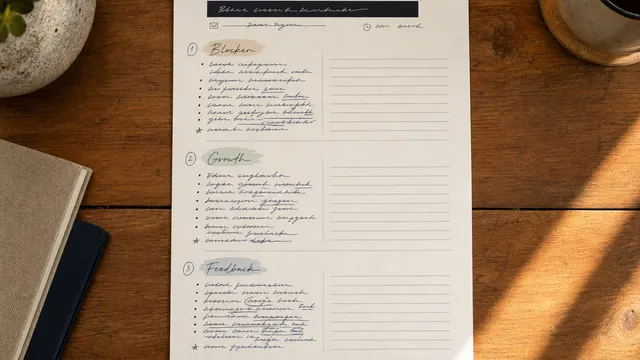
Your Manager Has a 1:1 Playbook. You Need a Prep Habit.
Everyone agrees one-on-ones matter — almost nobody teaches engineers what to put in the shared doc before the calendar ping.
5 min · June 14, 2026